The Shamanism of Mothers: Blood, Rock, and Litany
There is no denying that shamanism is "having a moment." Today, anyone can claim a title once reserved for the very few. Furthermore, shamanism has been elevated to something it is not—or rather, not only—which is contact with spirits and energetic work. Many modern practitioners boast of communing with spirits whose names or countenances they do not know, yet they disregard the day-to-day living miracles of the physical world.
I admit, it took me years to grasp what a shaman truly is and what their role entails. My original idea was informed by documentaries of Indigenous peoples wearing traditional skins, bones, and feathers; spending days by the fire, smoking, and giving counsel. These were depictions of shamans as figures within a society but also somewhat outside of it—not entirely human, and yet, perhaps more human than anyone else.
The Western world, starved of its original forms of spirituality, has adopted practices and rituals gathered (or stolen) from societies untouched by the destructive tentacles of the Church. This proliferation of books teaching "shamanism" and energy work has given rise to an unprecedented number of self-taught practitioners lacking accountability or guidance, opening doors that are sometimes best kept closed. Consequently, shamanism has become a sought-after profession in the West, rather than the "curse" it was often perceived to be by those traditionally called to serve.
But what would an indigenous European shamanism look like today, had its roots never been severed? Where would an indigenous Italian shaman live and practice in the 21st century? In truth, she would not be dressed in archaic costumes. While perhaps living somewhat apart, she would still be a participant in modern society: she would have a job, pay taxes, go to the supermarket, be married, and have children in public school. This is the shaman’s true role: to be in society so as to be of guidance to society. As much as we may romanticize the idea, a shaman from South America cannot truly address the soul-sickness of a Westerner in the same way; our cultural landscapes are simply too unrelatable.
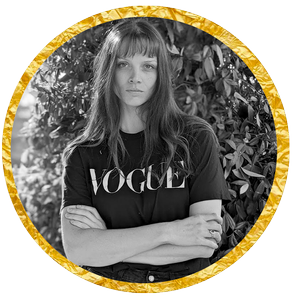
It is within this intersection of the ancient and the ordinary that we find Michela Chiarelli. She does not perform the role of a shaman; she lives the reality of one. In her, the lineage survives as a living adaptation to the modern world, not as a museum piece. To understand this tradition is to look past the lack of artifice and recognize that the "everyday" is precisely where the sacred is most needed.
I asked Tiziana for her thoughts on the tradition we have been adopted into, and her perspective on the work of Michela Chiarelli:
”Every time, I 'fall for it.' Every time a problem arises or a mystery reveals itself, I expect a shamanic response that is equally 'strange' or 'mysterious.' Instead, Michela observes the problem from every angle, reduces it to its simplest terms, and then smiles, extracting its real face from the tangle with sublime simplicity.
The explanation is "simple" and traces its raison d'être back to everyday events and objects. Events and objects that only prejudice or fear rendered "mysterious and strange." There it is. The greatest flaw of Michela CHIARELLI, what penalizes her in a world dominated by appearance, is her SIMPLICITY. The Light that is aimed toward the darkness dissolves it. The fear of the horrifying monster hidden within it, or even just the uncertainty of the unknown, give way to a project, a simple program to be followed and implemented with serenity. And Simplicity.”
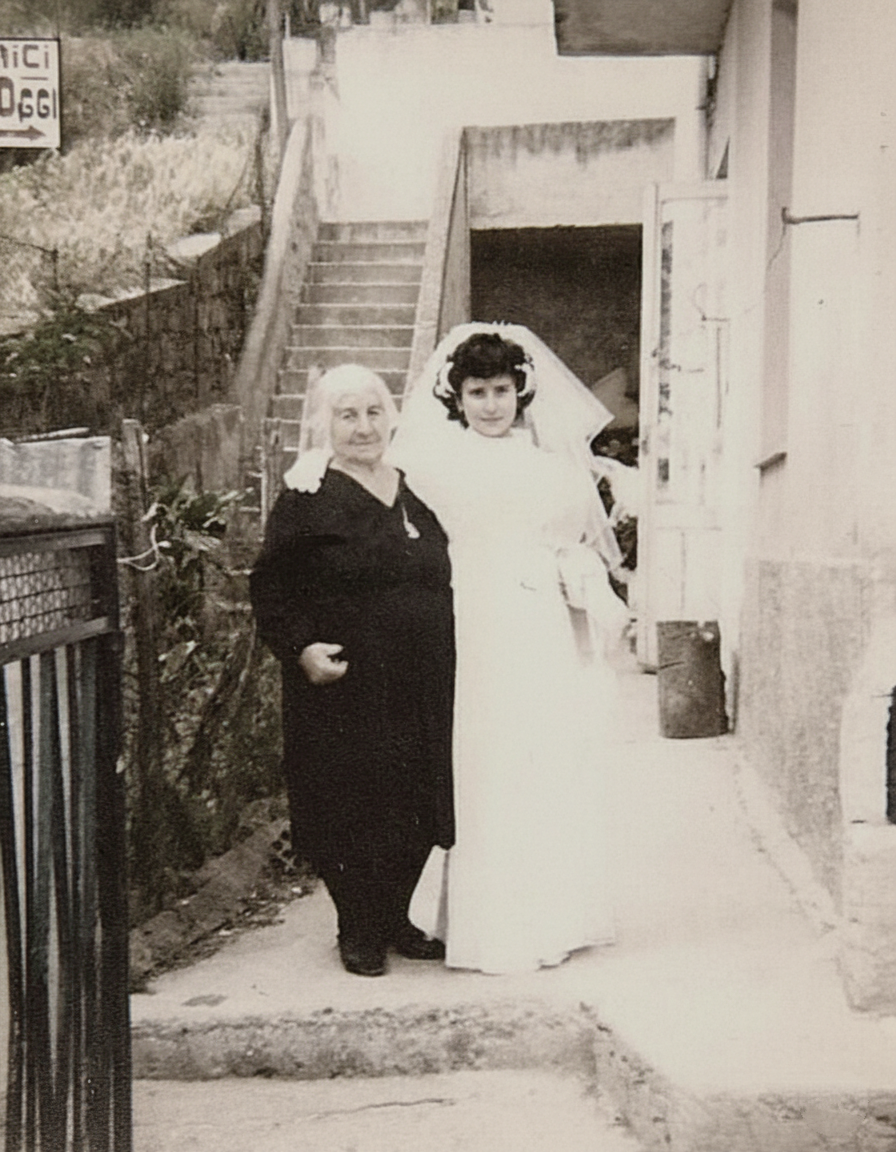
Michela Chiarelli with Nonna Malva, on her First Communion in Calabria
The Way of Michela Chiarelli
There is a shamanism that is not learned in weekend workshops, but is etched into the bones through the cold of waterfalls and the darkness of caves. It is the Italian shamanism of Michela Chiarelli, keeper of a tradition that has flowed from mother to daughter for seven generations, a heritage that lives today in Erian Soul Design.
In this path, it is not man who dominates nature, but nature that, through extreme trials, decides if you are worthy of hearing its voice.
The 5 Truths that Distinguish it from Core Shamanism
While Core Shamanism seeks to make the practice accessible and universal, Michela’s way is a path of real power and physical sacrifice, rooted in ancient and inflexible rules.
1. The Journey is a Physical Immersion, Not a Mental One In Core Shamanism, the journey often occurs through creative visualization. For Michela, the journey is matter: one physically descends into the bowels of the earth, into caves, or remains under the weight of freezing waterfalls. It is the thermal and physical shock, the brutal contact with the elements, that flings open the doors of perception. The spirit does not detach from the body; it inhabits it with more strength through the ordeal.
2. The Encounter with the Animal: True Nature The spirit animal is not an archetype chosen from a book. In Michela’s lineage, the animal finds you in the midst of the wild. It is an encounter that happens in the silence of the woods or in the quiver of the Mediterranean scrub. It is not a projection of the mind, but a presence that manifests when your scent becomes that of the earth.
3. The Sacrifice of Fasting and the Vision The Spirits do not reveal themselves on command. The vision is a reward that arrives only after a prolonged fast, exceeding a week. It is in the emptiness of the stomach and the silence of the body that the eyes stop seeing the veil and begin to glimpse the truth. It is a radical purification that transforms the Shaman into an empty and ready vessel.
4. The Astronomical Cycle in the Blood While many follow the calendar to celebrate the solstices, those who carry this tradition feel the change of the season before the astronomical cadence. Michela’s physical body senses the shift of energy, the change of the sap, and the breath of the earth in advance. The season is not a date; it is a vibration of the skin and bones.
5. Initiation: From Mother to Daughter The divinatory system is not a set of cards purchased in a store. In Michela’s shamanism, tools have credit only if they have been activated by hereditary transmission. It is the initiation from mother or grandmother to daughter (like the one received from Nonna Malva) and from wise woman to pupil (like the initiations received from Prisca, the last Sibyl; Mammaruzza, guardian of the Fire; Dimitra, lady of the Aegean; and Aunt Rosetta, constant Earth) that makes the Shaman a "transmitter of cosmic truths." Without the inner work and the passing of the torch, the tool remains silent.
The Litany: The Chant that Replaces the Drum
In this path, the drum gives way to the Chant and the Litany. It is the human voice which, modulated by the lineage, becomes the vibrational instrument par excellence. The litany is the golden thread that binds seven generations: an ancestral sound that does not beat from the outside, but resonates from within, calling the ancestors together and stabilizing the vision obtained through fasting and the cold.
"We do not ask the earth to speak to us; we make ourselves silent and strong enough to finally be able to hear it."
- Tanya, Tiziana, Michela